1. Introduction
On 22 July 2025, Taiwan’s Public Interest Whistleblower Protection Act 公益揭弊者保護法 (Ministry of Justice, Republic of China 中華民國法務部 2025) entered into force, formalizing legal shielding for public employees who disclose corruption, abuse of power, or breaches of public trust within their agencies. The Act aims to encourage reporting of public-sector wrongdoing by lowering its personal cost, and it does so through several instruments. Administered by the Ministry of Justice through a dedicated Whistleblower Protection Committee, it first defines a broad class of reportable wrongdoing, spanning malfeasance and corruption offenses as well as procurement, financial, environmental, labor, and public-health violations of sufficient gravity. It then establishes a tiered disclosure structure: A reporter ordinarily approaches an internal superior or designated unit, prosecutors or the judicial police, the supervising ministry, the Control Yuan, or an ethics office, and may turn to elected representatives, registered media, or public-interest groups only where those former channels fail to respond within the statutory window. And it prohibits an enumerated list of retaliatory measures—dismissal, demotion, pay reduction, denial of promotion or training, and adverse changes to working conditions—reinforced by a burden-shifting presumption: Once a reporter shows that a protected disclosure preceded an adverse measure, the employer must prove it would have taken the same measure regardless. The Act further requires that the whistleblower’s identity be kept confidential, allows case records to be prepared under a code name although the disclosure itself must be named, and provides monetary rewards where a disclosure leads to wrongdoing being substantiated.
The legislation marks a significant institutional commitment, but it leaves open a behavioral question: Will protection alone make civil servants speak up? Decades of voice research suggest not. Employees often remain silent even when legal channels exist, calibrating their decisions against organizational climate, perceived efficacy, and personal capability (Elizabeth W. Morrison 2014; Elizabeth Wolfe Morrison and Milliken 2000).
The theory of planned behavior (TPB) holds that a behavior follows from the intention to perform it, and that this intention is in turn shaped by three factors: the actor’s attitude toward the behavior, perceived social norms, and perceived behavioral control (Ajzen 1991). Empirically, Zhang et al. (2025) recently used the 2016 Taiwan Government Bureaucrats Survey (TGBS IV) (Dong 2020) to test an adapted TPB model and report that attitudes, subjective norms, and perceived behavioral control jointly account for roughly a quarter of the variance in whistleblowing intent among Taiwanese civil servants. Their result establishes which factors matter on average. But the additive TPB specification they test, by design, treats the attitude-intent link as constant across organizational contexts. It is silent on a prior question: Under what conditions does a favorable attitude toward whistleblowing actually translate into reporting intent? If voice research is correct that capability and efficacy gate that translation, an additive model conceals more than it reveals, and policy designs built on average effects may misallocate effort.
This article advances three contributions. First, we draw on organizational voice theory to extend the TPB account: Voice theory supplies the reasons why the attitude-intent link should be conditional on the organizational context in which speaking up occurs (Hirschman 1970; Edmondson 1999; Elizabeth W. Morrison 2014). Second, we model conditional rather than purely additive effects, identifying two moderators of the attitude-intent link—perceived whistleblowing inefficacy (a commitment moderator) and organizational skill (a capability moderator). Third, we read these findings, cautiously, against the design choices facing the implementation of the 2025 Act.
Our central finding is that the relationship between attitudes and intent is conditional: it is strongest, counterintuitively, where civil servants perceive whistleblowing as ineffective (a committed-minority pattern), and it is amplified where they have the organizational skill to act on it (a capability pathway). The remainder of the paper proceeds as follows. Section 2 develops the theoretical case for treating the attitude-intent link as conditional. Section 3 describes the data and the two-stage estimation. Section 4 reports the main effects, the two moderation patterns, and the robustness battery. Section 5 develops the implications, particularly for the implementation of the 2025 Act.
2. Voice, Silence, and the Conditional Translation of Attitudes
2.1. From planned behavior to organizational voice
Whistleblowing is a particular case of organizational voice: the verbal expression of work-related ideas, concerns, or dissent through formal or informal channels (Elizabeth W. Morrison 2014). The dominant individual-level framework in the whistleblowing literature, the theory of planned behavior (TPB; Ajzen 1991), models reporting intent as a function of attitudes, subjective norms, and perceived behavioral control. Recent applications to public-sector samples, including Park and Blenkinsopp’s (2009) study of South Korean police officers and Zhang et al.’s (2025) analysis of Taiwanese data, find that an additive TPB specification accounts for a meaningful amount of variance in intent. Our argument is not that TPB is wrong, nor that its constructs are irrelevant: Subjective norms and perceived behavioral control are themselves designed to capture contextual influence. Our point is narrower and empirical. An additive estimation of TPB—the form in which it is typically tested—treats the attitude-intent slope as constant across respondents, and this masks systematic variation that a large voice-theoretic literature would lead us to expect (Elizabeth Wolfe Morrison and Milliken 2000; Detert and Edmondson 2011). Voice theory, in other words, tells us where to look for the conditions under which attitudes do and do not convert into intent.
This matters because voice theory predicts systematic, not random, moderation. Pro-whistleblowing attitudes signal endorsement of the act in principle; converting that endorsement into intent depends on whether the actor can act on it (capability) and on how they read the prospective act’s likely consequences (efficacy). This yields two testable interactions: a positive interaction between attitude and capability, and—less obviously—a positive interaction between attitude and perceived inefficacy. Neither is captured by an additive specification, and both should be observable in the very dataset used to fit that specification. Taiwan is an instructive setting for these mechanisms rather than an incidental source of data. Its civil service is organized around a centralized, examination-based meritocracy that favors generalist exam performance over agency-assessed operational competence, within a strongly hierarchical administrative tradition that places a high premium on deference to authority and organizational loyalty (So 2015; Kuo and Huang 2026). Two consequences follow for our mechanisms. First, this examination-driven recruitment widens the gap between holding a pro-whistleblowing attitude and actually commanding the organizational skill to act on it. Second, where norms of loyalty and deference make dissent costly in reputational and relational terms—a cost that comparative evidence finds particularly salient for Taiwanese employees, given the weight of guanxi and relational ties (Clark et al. 2020)—the selection-on-cost logic behind the committed-minority pattern becomes especially pronounced: Speaking up against one’s own agency runs against a strong normative grain, so those who still express the intent are disproportionately the strongly committed.
2.2. Capability as a moderator
Whistleblowing is not merely a moral stance; it is a sequence of organizational moves. The would-be reporter must work through the right channel, build a defensible account, anticipate procedural friction, and manage the interpersonal repercussions of dissent across an investigation timeline. These are coordination-intensive behaviors, not by-products of conviction (Detert and Treviño 2010); whether they succeed in getting wrongdoing addressed turns on the would-be reporter’s organizational power, the legitimacy of their role, and the support of others (Near and Miceli 1995).
We proxy one component of this capacity—the interpersonal coordination it draws on—with the construct of organizational skill, a three-item scale (α = 0.86) capturing respondents’ self-assessed ability to work effectively with and through others within the organization: “I can turn conflict into constructive outcomes” (q67), “I can forge members of different backgrounds into a cohesive team” (q68), and “I can make subordinates understand their importance to completing tasks” (q70). It is distinct from control over the reporting act itself. The two constructs sit at different points in the voice process: Perceived behavioral control is the actor’s subjective expectancy that they could carry out the behavior, whereas organizational skill is a possessed relational resource—the standing capacity to coordinate and mobilize others—that does the work of converting an endorsing attitude into a feasible course of action.
Because one item refers to subordinates, the measure is in part conditioned on holding a supervisory role; we treat organizational skill as a resource correlated with organizational position rather than independent of it. We therefore treat it as conceptually adjacent to, but distinct from, the perceived behavioral control of TPB: It concerns the interpersonal and organizational navigation that giving voice to dissent requires. We acknowledge, however, that because organizational skill is operationalized through self-assessed items, it shares empirical content with self-efficacy and perceived behavioral control; the distinction we draw is in the first instance theoretical, and we return to these measurement implications in §5.4. We expect organizational skill to amplify, not substitute for, the attitudinal motive. The employee who endorses whistleblowing but lacks this navigational capacity may decline to report—not because they reject the act, and not from any incapacity to grasp it, but because they cannot mobilize the interpersonal support and coordination that carrying it out requires.
H1. Organizational skill positively moderates the relationship between attitude toward whistleblowing and whistleblowing intent.
2.3. Inefficacy and the committed minority
The second hypothesized moderator is more counterintuitive. Perceived whistleblowing inefficacy—the belief that reporting will not actually produce institutional change—should, on average, depress voice. Yet among the subset who would still report despite that belief, perhaps attitude would carry more of the explanatory weight. The logic is one of selection on cost: Where the system is perceived as responsive, even a modest endorser can act, because the expected return is high relative to the expected cost; where whistleblowing is perceived as futile, that expected return collapses, and only respondents with strong attitudinal motive retain enough reason to bear the cost. This logic parallels a long-standing finding in the study of high-cost collective action—that as the cost of participation rises, a favorable attitude becomes necessary but not sufficient, and participation is increasingly confined to the most strongly committed (McAdam 1986).
The observable implication here would be not a negative interaction (the conventional reading that “inefficacy suppresses voice”) but a positive one: The slope of attitude on intent is predicted to steepen as perceived inefficacy rises. We refer to this as a committed-minority pattern. We note at the outset that our data are cross-sectional, and so we treat this as a pattern consistent with selection on cost rather than as direct evidence of a sorting process unfolding over time; we return to this limit in Section 5.1.
For clarity, we use a single graded vocabulary throughout for position on the attitude scale: A strong endorser holds whistleblowing attitudes high enough to report even when the perceived cost is high; a modest (or, interchangeably, marginal) endorser holds favorable but weaker attitudes and acts only when the perceived cost is low; and the median civil servant denotes the typical respondent at the center of the attitude distribution.
H2. Perceived whistleblowing inefficacy positively moderates the relationship between attitude and whistleblowing intent.
H3. The two moderators are distinct mechanisms: Capability operates by lowering procedural friction, while inefficacy operates by selecting on commitment intensity. We test H3 informally by inspecting whether each interaction survives the inclusion of the other.
3. Data and Methods
3.1. Data and dependent variable
We use the 2016 Taiwan Government Bureaucrats Survey (TGBS IV) (Dong 2020), a stratified-sample survey of Taiwan’s central- and local-government civil servants administered by a National Chengchi University research team (N = 1,004 after listwise deletion on the analysis variables). The dependent variable is a standardized composite of six items asking respondents how likely they would be (0–10) to report each of six categories of wrongdoing in their agency: improper management, theft of public property, breach of laws or regulations, abuse of authority, waste of public funds, and corruption (α = 0.93). This composite differs from the single-item operationalization in Zhang et al. (2025) by capturing intent across the breadth of wrongdoing rather than corruption alone, yielding a more reliable outcome for testing the conditional structure of voice. The two focal moderators are measured as follows: Perceived whistleblowing inefficacy is a single item recording agreement that reporting ultimately produces no effect, and organizational skill is a three-item scale (α = 0.86).
3.2. Variable selection and estimation
Because the TGBS IV provides over eighty candidate predictors, including standard TPB constructs, voice- and silence-related items, and squared and interaction terms, we adopt a two-stage strategy. In the first stage, we use Elastic Net with 5-fold cross-validation on a 60% training fold to retain a sparse predictor set. The selected variables are then re-estimated by OLS on the full sample with HC3 heteroskedasticity-robust standard errors. Two technical notes follow Belloni et al. (2014). First, we treat the OLS step as post-selection inference and report Oster (2019) sensitivity in §4.3 to gauge how much unobserved-confounder strength would be required to overturn each estimate. Second, interaction terms enter the model after orthogonalization against their constituent main effects, reducing mechanical collinearity (all variance inflation factors remain below 2.5; full diagnostics in Online Appendix B).
4. Results
4.1. Main predictors
Table 1 reports the OLS estimates with HC3 standard errors. The model explains 44.3% of variance in whistleblowing intent (adjusted R² = 0.426; F = 24.10).
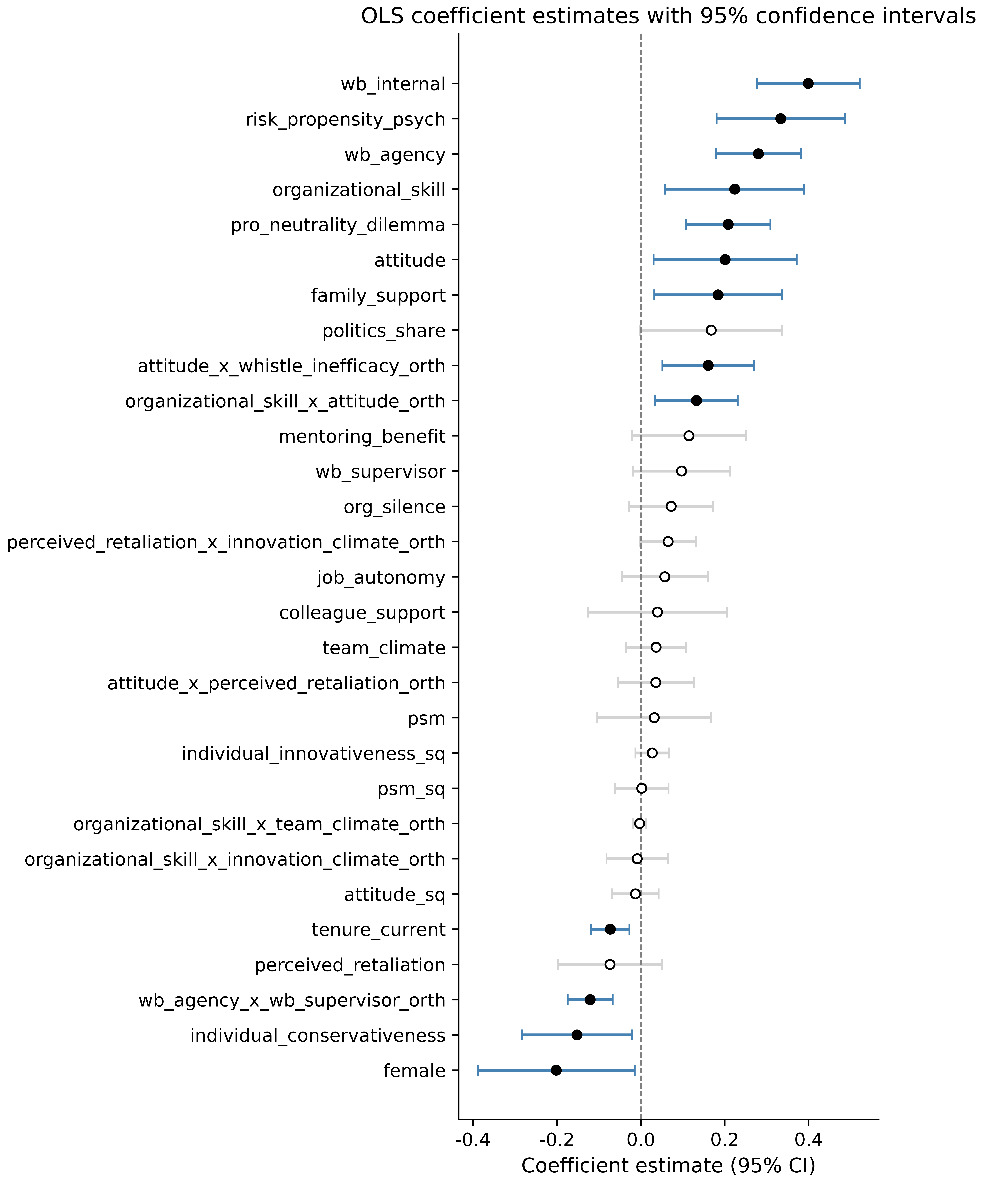
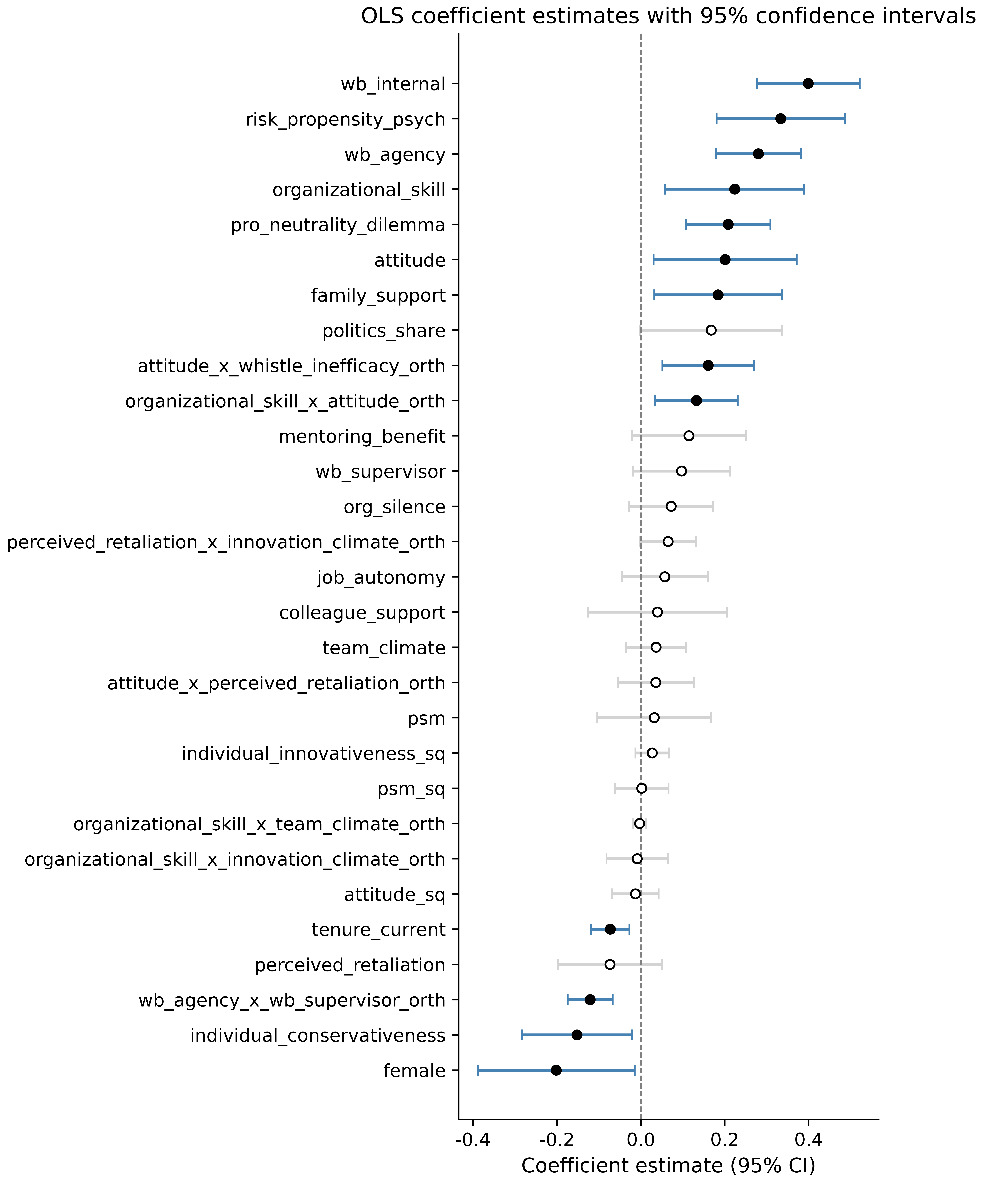
Three patterns deserve highlighting. First, two of the channel-preference variables, willingness to report internally and to the agency, load very heavily on the composite intent measure, as is expected for items that are conceptually proximate to the dependent variable. We retain them for completeness but interpret substantive findings against models that drop them; conclusions are unchanged (Online Appendix C). Second, among substantive predictors, attitude toward whistleblowing (β = 0.20, p = 0.02), psychological risk-taking propensity (β = 0.33, p < 0.001), the pro-neutrality dilemma (β = 0.21, p < 0.001), organizational skill (β = 0.22, p = 0.008), and family support (β = 0.18, p = 0.02) all push toward intent. Conversely, individual conservativeness (β = −0.15, p = 0.02), tenure in current position (β = −0.07, p = 0.002), and female gender (β = −0.20, p = 0.03) attenuate it. Figure 1 visualizes the full coefficient battery.
4.2. Conditional effects: inefficacy and skill
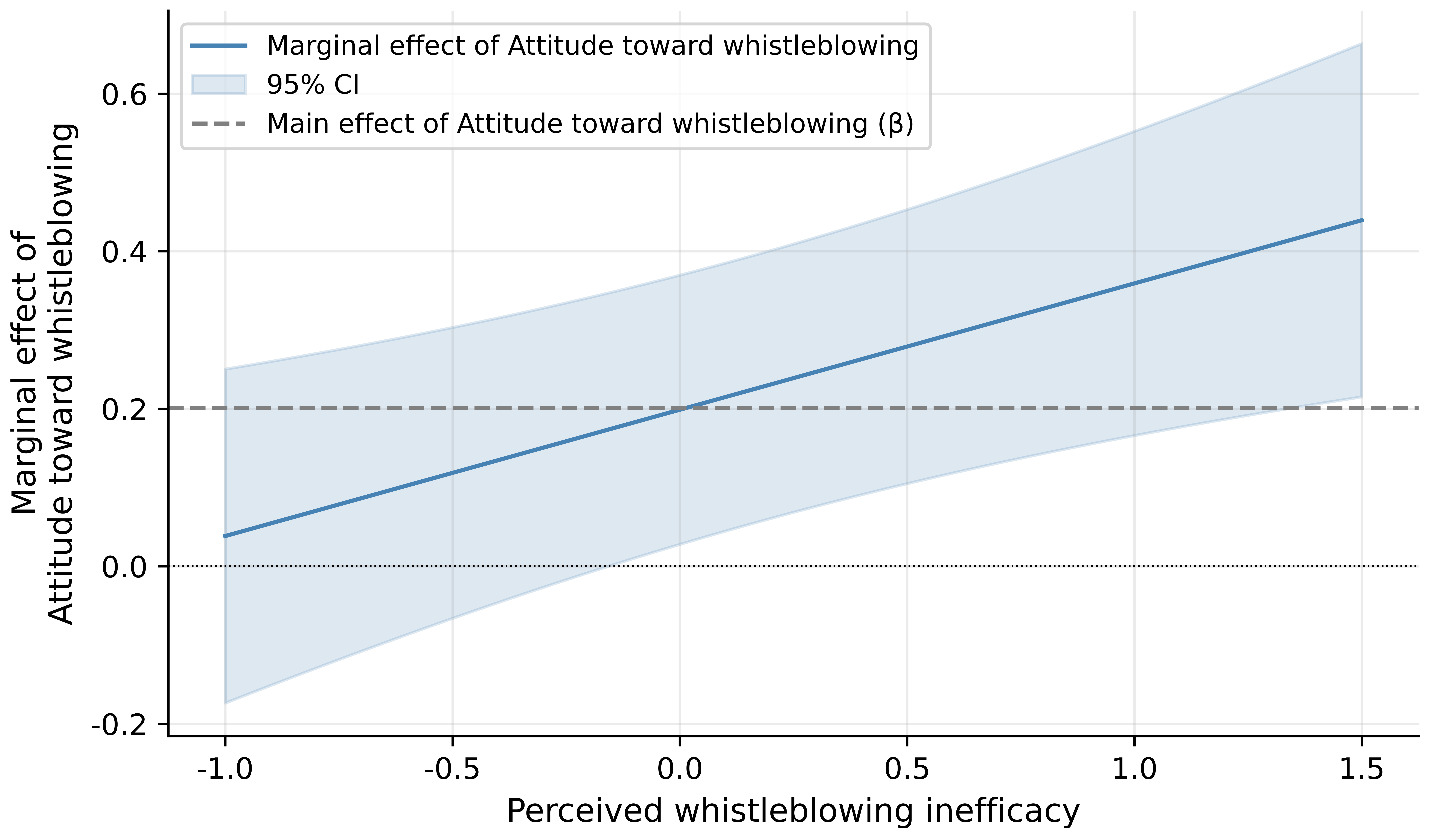
Two of the retained interactions reach conventional significance. Figure 2 plots attitude’s marginal effect across the observed range of perceived whistleblowing inefficacy, holding all other covariates at their means.
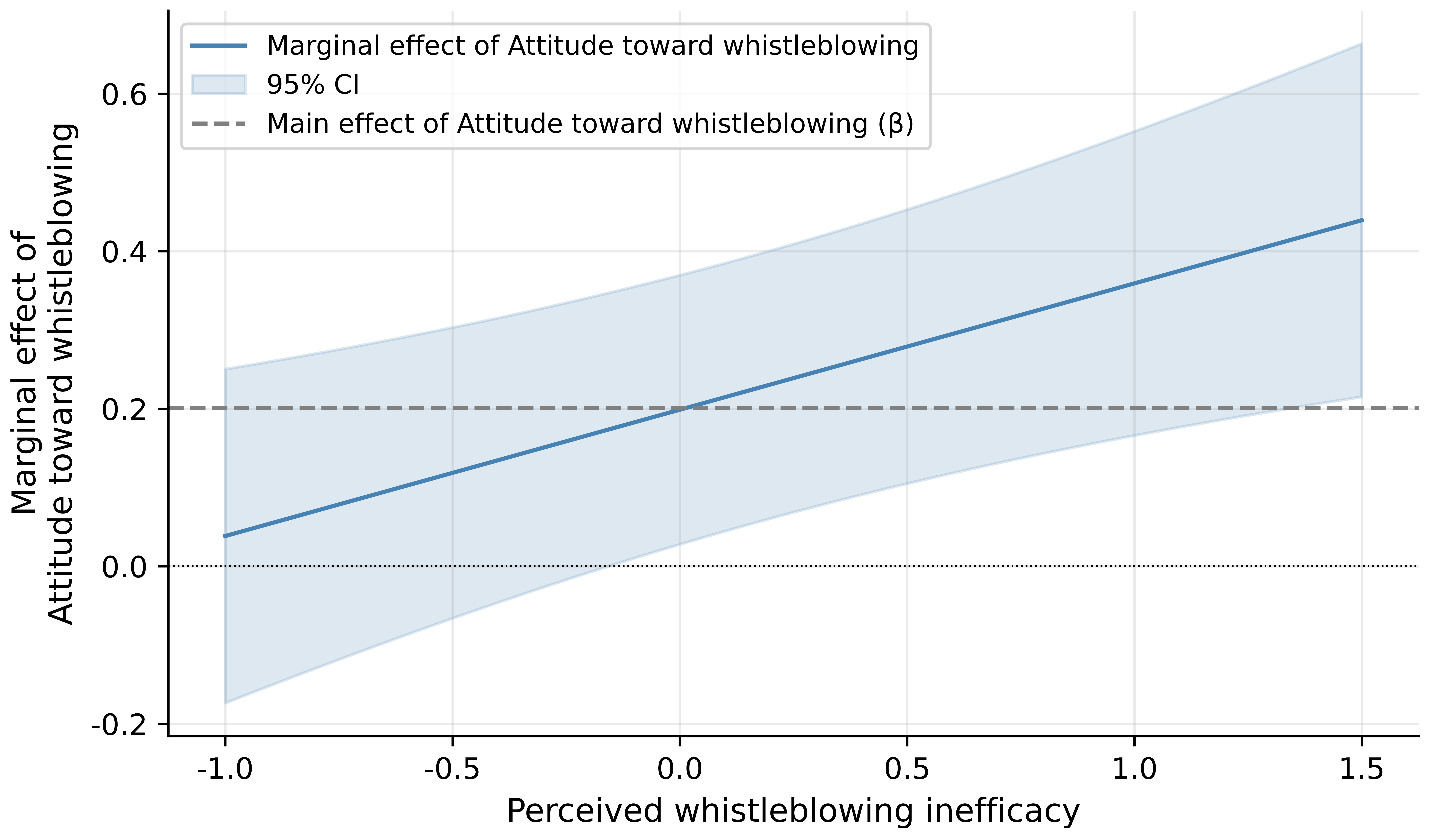
At low inefficacy—among civil servants who believe whistleblowing produces real institutional change—the marginal effect of attitude is statistically indistinguishable from zero. Modest and strong endorsers report at similar rates, presumably because the perceived return on reporting is high enough to motivate even the modest case. As inefficacy rises, attitude’s slope steepens monotonically. At the upper end of the inefficacy range—among civil servants who believe the system will not respond—the marginal effect of attitude is roughly twice the unconditional estimate. This is the committed-minority pattern: Where the system seems futile, expressed intent is concentrated among the strongest endorsers. H2 is supported.
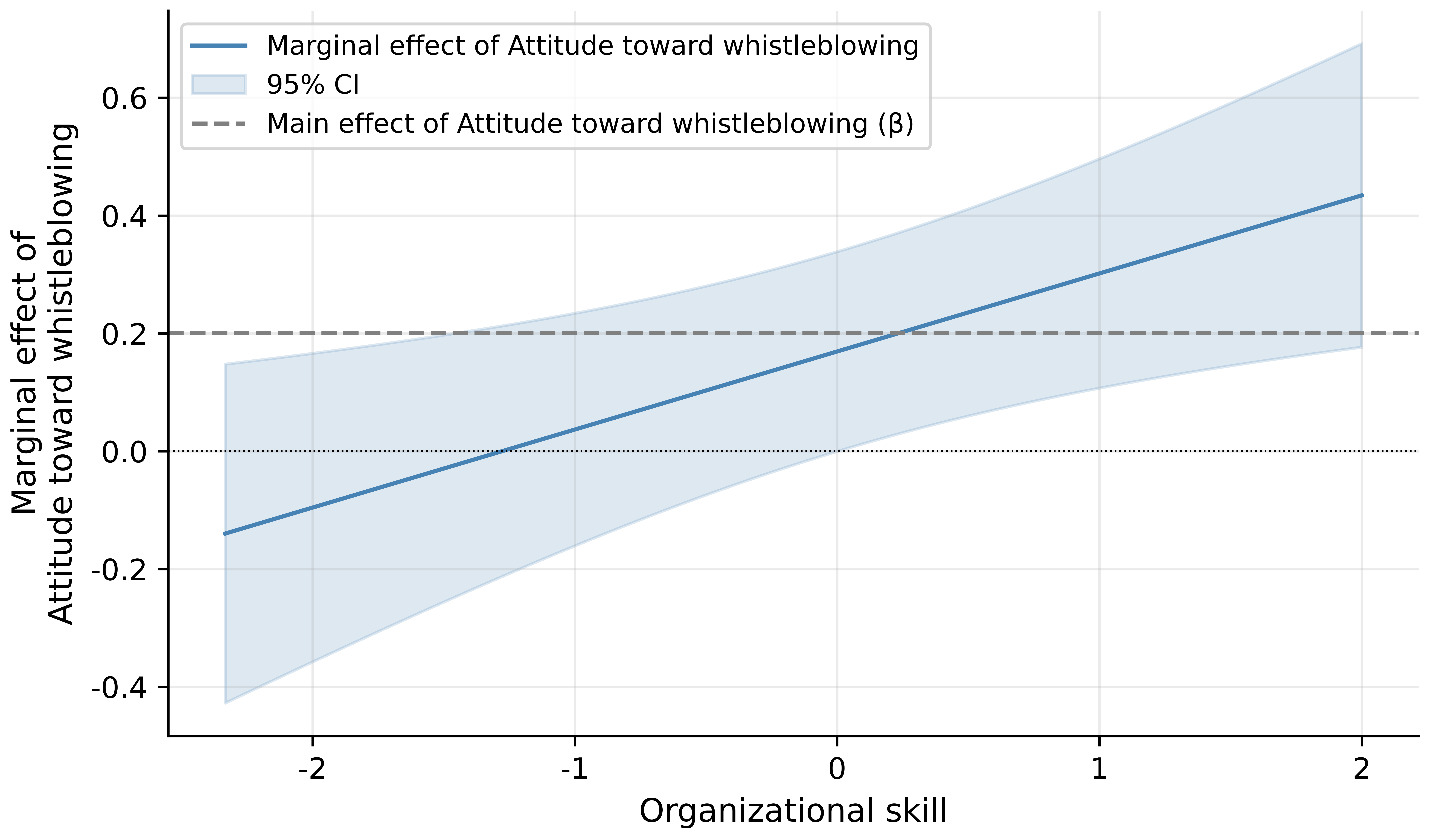
Figure 3 displays the analogous moderation by organizational skill (β for the interaction = 0.13, p = 0.008).
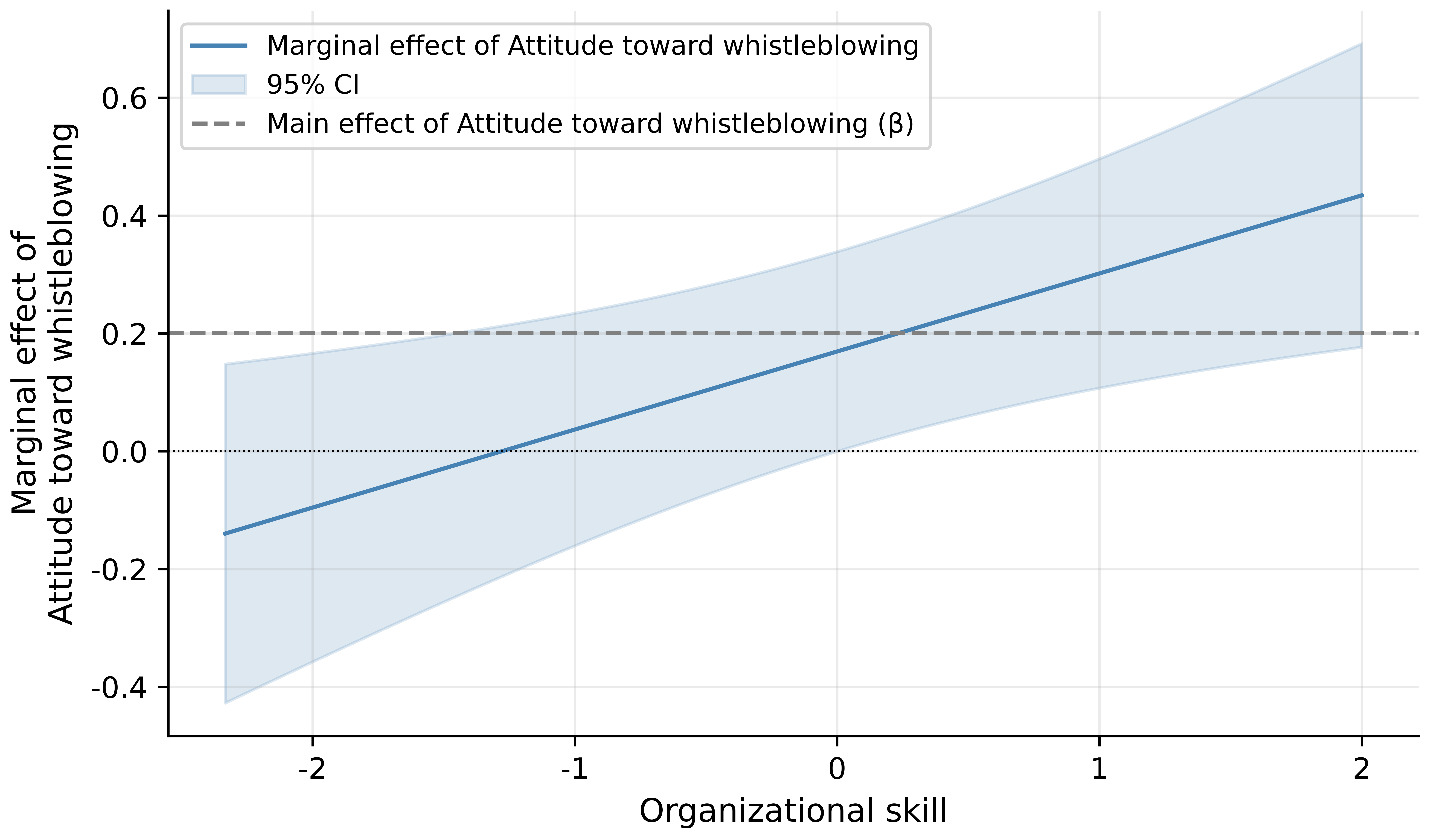
At low skill—among civil servants who report little capacity to coordinate and mobilize others—the marginal effect of attitude on intent is near zero and statistically indistinguishable from zero. Without that organizational capacity, even strong endorsement does not translate into intent. As skill rises, attitude’s slope grows monotonically positive, reaching roughly twice the unconditional estimate at high skill. The reading is consistent with the capability argument in §2.2: Organizational skill is the bridge from endorsement to action, not a competing predictor of it. H1 is supported. Both interactions remain significant when included jointly in the model (Online Appendix B), consistent with H3’s claim that the capability and commitment mechanisms are distinct.
4.3. Robustness
Four diagnostics are worth flagging; full output is in Online Appendix B. First, all variance inflation factors are below 2.5, with most predictors well under 2, the orthogonalization procedure has worked, and collinearity is not driving the interaction terms. Second, the Breusch–Pagan test rejects homoskedasticity (LM = 85.70, p < 0.001), which is why we use HC3 standard errors throughout; substantive conclusions are unchanged under conventional OLS standard errors. Third, the Ramsey RESET test is non-significant at both second-order (F = 1.77, p = 0.18) and third-order (F = 1.34, p = 0.26) specifications, providing no evidence of obvious functional-form misspecification. Fourth, Oster (2019) sensitivity on the focal attitude × inefficacy interaction yields |δ*| ≈ 10.13, classed as “strong.” Selection on unobservables would need to be roughly ten times as severe as selection on observables to nullify the coefficient. The capability interaction is likewise strongly robust (|δ*| ≈ 6.77); the organizational-skill main effect alone is more modestly robust (|δ*| ≈ 1.04). We treat the committed-minority interaction as the more reliably identified finding but note that all conclusions condition on a baseline of cross-sectional design.
5. Discussion
5.1. The committed-minority puzzle
The committed-minority finding deserves emphasis because it complicates the conventional reading of efficacy in voice research. The dominant intuition—that efficacy enables voice and inefficacy suppresses it—holds as an average effect; what our interaction adds is that among those who would voice despite low perceived efficacy, attitude does comparatively more of the work. One reading consistent with this pattern is that, where speaking up looks futile, expressed intent is increasingly confined to the strongly committed while modest endorsers fall away—a selection-on-cost reading of voice (Hirschman 1970; Elizabeth Wolfe Morrison and Milliken 2000) that echoes work on commitment under high cost in the social-movement literature (McAdam 1986). We advance this as an interpretation, not a demonstration: A cross-sectional interaction shows that the attitude-intent slope steepens with perceived inefficacy, but it cannot by itself establish that a sorting process is operating, and other mechanisms could in principle generate the same slope. What we can say more firmly is that the pattern has not, to our knowledge, been documented in the whistleblowing literature, which has tended to model efficacy as an additive main effect; an additive specification on these same data averages over the steepening slope rather than recovering it.
5.2. Capability is not the same as motivation
The H1 finding carries a different theoretical valence and a different policy implication. Organizational skill is not redundant with attitude: Its positive moderation indicates that endorsement and the capacity to act on it are separable inputs into voice. Two implications follow. First, the policy-relevant quantity is not the share of civil servants who hold pro-whistleblowing attitudes but the share who hold those attitudes and also have the organizational capacity to act on them; instruments that measure only the former will overstate the latent pool of would-be reporters. Second, this capacity is more plausibly developed through training than attitudes are, which makes it the more tractable policy lever. Attitudes tend to form early and stabilize after the impressionable years, shifting slowly and largely outside an agency’s direct control (Krosnick and Alwin 1989), whereas procedural and organizational competence can be cultivated through structured guidance and practice—though we would caution that building genuine competence in a domain where a civil servant’s career may be at stake requires sustained investment, not a one-off session.
5.3. Implications for the 2025 Whistleblower Protection Act
These two findings suggest design considerations for the implementing regulations of the Public Interest Whistleblower Protection Act, whose structure was set out in §1. We highlight two considerations, offered tentatively given the data limits discussed below. First, legal shielding addresses the perceived-retaliation component of behavioral control but does comparatively little, on its own, to raise perceived efficacy (a recent vignette experiment with Taiwanese civil servants found that accountability reminders alone did not move whistleblowing intention; Kuo and Huang 2026): The Act’s credibility is likely to hinge on whether implementing agencies are seen to act on completed investigations, not only on the penalties they enumerate for retaliation. The Act’s statutory reward—set at no less than a tenth of the penalties recovered—works on the return side of this calculus, but it too depends on cases being pursued to a recovery. There is, moreover, a tension our model does not resolve. Public disclosure can enhance the perceived efficacy of reporting, yet it also raises the whistleblower’s exposure; the legal protection that is meant to lower the cost of voice and the publicity that is meant to raise its efficacy can therefore work against one another in practice, and the regulations must balance them rather than assume they reinforce. Second, agencies might invest in procedural and organizational support—clear reporting workflows, named ethics officers, and protected channels—that lower the navigational threshold facing a would-be reporter. Absent such support, the Act risks drawing responses mainly from the most strongly committed while leaving the median civil servant favorable in attitude but hesitant in practice.
5.4. Limitations
There are three principal limitations to this analysis. First, the 2016 TGBS IV predates the 2025 Act by nearly a decade. Our findings are best read as a pre-policy baseline against which the Act’s effect might in principle be evaluated; they are not themselves a test of the Act, and the policy considerations above should be read in that light. Relatedly, a number of factors likely to matter under the new legal framework are not observed in these data—among them perceptions of the new law’s credibility, direct experience of retaliation, trust in specific reporting channels and the anonymity protections the Act now affords, prevailing organizational culture, supervisory conduct, and agency-level enforcement practice—so the conditions we model are only part of the post-Act picture. Second, the dependent variable is intent, not behavior, and the well-known attitude-behavior gap may reassert itself at the step from intent to actual disclosure; throughout, our claims concern reporting intent rather than realized reporting. Third, the three channel-preference variables (wb_internal, wb_agency, wb_supervisor) are conceptually proximate to the composite intent measure; we re-estimate without them in Online Appendix C and find the focal interactions and the H1/H2 conclusions preserved (attitude × inefficacy β = 0.14, p = 0.01; organizational skill × attitude β = 0.12, p = 0.02).
Beyond these three, two measurement caveats bear specifically on the capability mechanism. First, organizational skill is captured by self-assessed items and so cannot, on these data, be cleanly separated from the perceived behavioral control of TPB; the distinction we draw in §2.2 is theoretical, and a measure of the possessed resource independent of self-perception would be needed to establish it empirically. Second, because one of its items refers to subordinates, the scale is in part conditioned on holding a supervisory role, so it partly reflects organizational position rather than a capacity fully separable from it; a measure that did not presuppose a supervisory vantage point would be needed to isolate the resource itself.
6. Conclusion
Whistleblowing intent in the public sector is not the simple sum of an attitude, a norm, and a sense of behavioral control. It is better understood as an attitude made conditional—on the organizational capacity to act on it or, where that is absent and the act looks futile, on unusually strong commitment. The 2016 TGBS IV data, the same data that support an additive TPB account of public-sector whistleblowing, also reveal, under a conditional specification, two systematic moderation patterns: a capability pathway, in which organizational skill amplifies the attitude-intent link, and a committed-minority pattern, in which perceived inefficacy steepens it. Both are individually robust, and both carry design considerations for the implementation of Taiwan’s 2025 Public Interest Whistleblower Protection Act—suggesting that whether the Act translates conviction into reporting intent will depend not on legal shielding alone but on the institutional credibility and organizational capability built alongside it. A favorable attitude toward whistleblowing, in other words, does not by itself produce the intent to report; it does so when the organization gives that attitude somewhere to go.