

Introduction
On 27 May 2025, the Taipei District Court ruled to extend the detention of Ko Wen-je—former Taipei Mayor and founding chairman of the Taiwan People’s Party—and three other defendants, while also suspending their visitation and communication rights. The case traces back to August 2024, when Ko agreed to an internal party investigation regarding political donations. In September, he was taken by the Agency Against Corruption to the Taipei District Prosecutors Office for questioning over a property development project during his mayoral term. By December 2024, Ko was formally indicted on charges of bribery, profiteering, embezzlement, and breach of trust.
Ko Wen-je, founding chairman of the Taiwan People’s Party (TPP), positioned the party as an alternative to the dominant Democratic Progressive Party (DPP) and Kuomintang (KMT). In the 2024 election, the TPP secured eight at-large legislative seats, denying either of the major parties a legislative majority. As Nachman (2024) argues, this positioned the TPP as a disproportionally influential force and legislative kingmaker. Nachman also analyzed the evolution of small parties in Taiwan’s electoral system. Since the TPP’s influence heavily relies on Ko’s charisma (Stackler 2023; Hioe 2025),[1] understanding the party requires examining its leader. Yan and Heng (2016) discussed Ko’s political entrepreneurship—problem identification, leading by example, and team-building—while Du (2024) explored his image-crafting and communication tactics. Stackler (2023) reviewed Ko’s broader third-party strategies, and Hioe and Nachman (2023) traced his political arc, noting his shift from pan-Green to pan-Blue associations and his fusion of divergent political styles. Departing from previous qualitative studies, this research uses Google Trends data to quantify Ko’s political ascent and decline.
Many survey-based analyses have examined Ko Wen-je and his TPP. These studies typically rely on structured, direct questions posed to selected samples. While valuable, such surveys often lack nuance and cannot capture historical sentiment. In contrast, Google Trends—an online tool that tracks the popularity of search topics—offers a broader and more dynamic view. Given Ko’s particular appeal among Taiwan’s younger population, internet-based tools like Google Trends are especially useful for painting a fuller picture of his political impact.
This short note is structured as follows: Section 1 introduces Taiwan’s internet landscape and explains Google Trends as a data source. Section 2 explores the rise and fall of Ko’s popularity using Google Trends data. Section 3 focuses on Ko’s role in the 2024 presidential election. Section 4 concludes the paper.
1. Data Source
This section begins by examining Taiwan’s internet landscape to provide essential background. It then introduces Google Trends as the primary data source, highlighting its key features and its usefulness in capturing public narratives and opinion—particularly among specific demographic groups.
According to the Taiwan Network Information Center (2024), Taiwan’s internet penetration reached 88.4 percent in 2024, up from 84.7 percent in 2023, showing a general upward trend.[2] However, two caveats should be noted. First, internet usage declines sharply among those aged 60 and above. This means internet-based public opinion may not fully reflect the entire population. This contrasts with other developed countries: In the U.S., demographic gaps between internet users and non-users are unlikely to significantly bias results[3]; in Australia, seniors aged 65+ engage online at rates comparable to those of younger cohorts (Australian Communications and Media Authority 2023). Therefore, this study reflects primarily an online perspective.
Another issue concerns Google’s dominance as a search engine in Taiwan. Google has held over 80% market share only since 2016, while prior to 2011, Yahoo was a significant—and at times dominant—player.[4] This study includes some Google Trends data dating back to 2004, which may risk misrepresentation due to lower market penetration at that time. However, despite the limited early data, fundamental analyses have been performed to ensure overall accuracy.
Google Trends (https://trends.google.com/trends) measures the popularity of search queries across regions and languages. It features user anonymity, topic categorization, and data aggregation, making it useful for research. The data is time- and location-adjusted and shown on a 0–100 scale: 100 indicates peak popularity, 50 is half that, and 0 means insufficient data. This standardized scale normalizes interest levels, allowing comparisons across regions and time. Identical scores may reflect different search volumes, but the values consistently show relative popularity within specific contexts. Google Trends data have been widely used across fields such as information systems, computer science, healthcare, political science, international relations, economics, business, and finance (Jun, Yoo, and Choi 2018). In political science, it typically serves as a measure of issue salience (Dancy and Fariss 2024). Google Trends offers a valuable means to gauge the collective impact of issues on public attention, capturing the interplay of factors such as policy decisions, media coverage, and individual curiosity. Google Trends can be used to gauge narratives—discourses with a clear sequence that link events meaningfully, offering insight into the world or personal experience (Hinchman and Hinchman 1997).
Google Trends has some limitations. First, it uses sampling rather than full search data. While typically reliable due to Google’s large volume, low-interest topics may face sampling errors. To address this, the study collects data on twelve separate days[5] and averages the results. Second, changes in Google’s data collection methods may cause measurement errors. To mitigate this, the study cross-checks peak search results, ensuring that the timing of search interest aligns with the emergence of key underlying factors.
2. Time Series Analysis
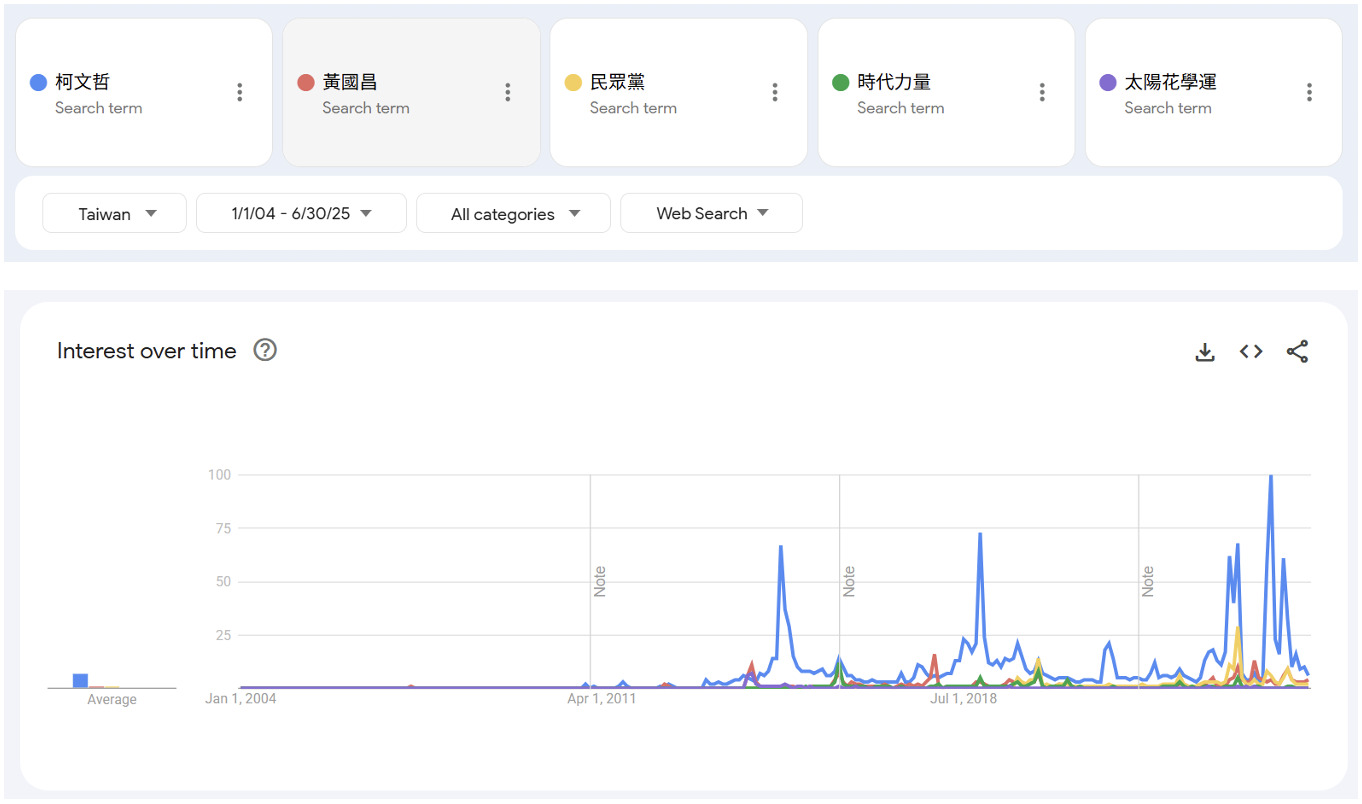
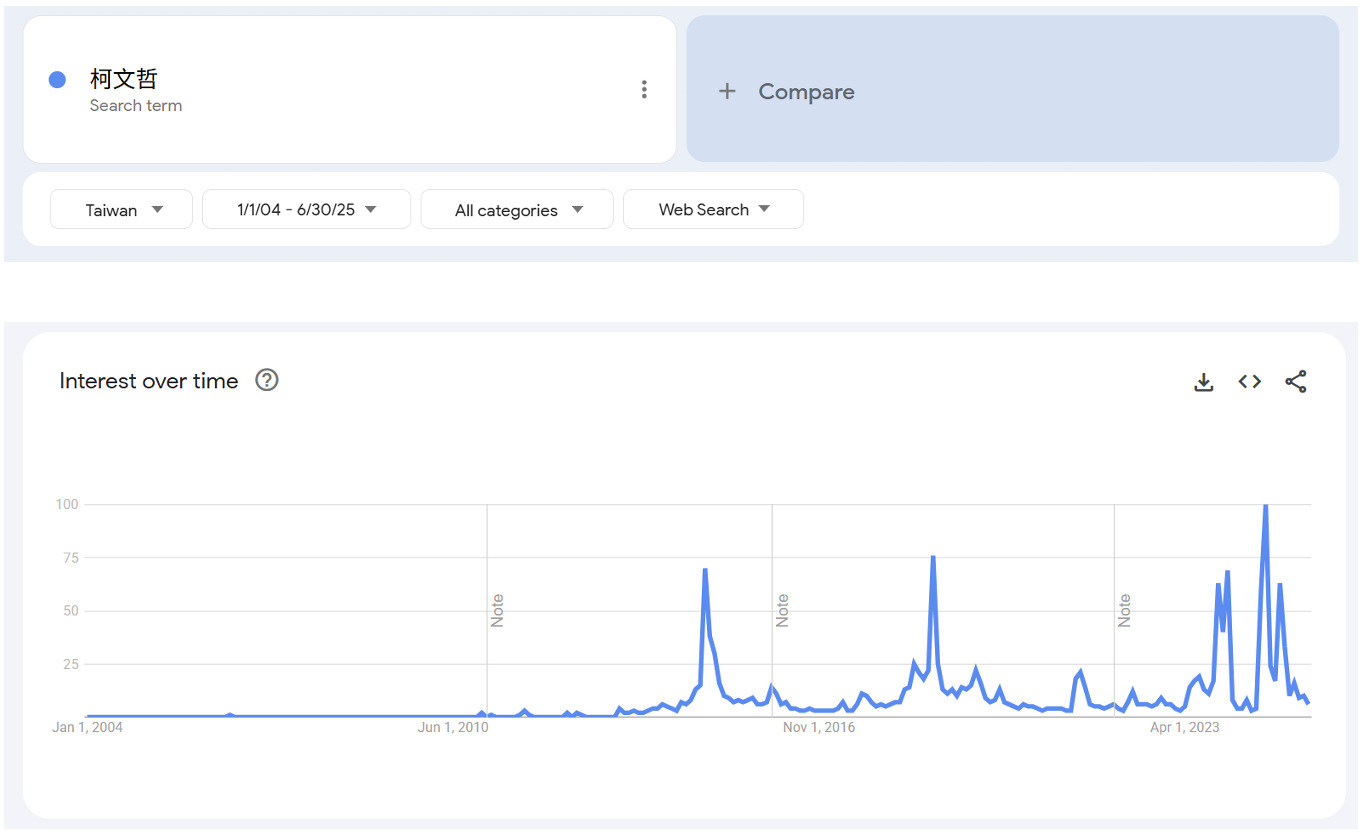
Figure 1 below presents Google Trends data for the search term “柯文哲” (Ko Wen-je) from January 2004 to June 2025 (for comparisons with Huang Kuo-chang, the TPP, the NPP (New Power Party), and the Sunflower Student Movement, see Appendix 1). This serves as a quantitative measure of Ko’s online narrative and public attention in Taiwan over this period. Using the arithmetic average of twelve Google Trends samples (available upon request) does not alter the results.
__january_2004--june_2025.png)
Figure 1 illustrates Ko’s rise and fall in online public attention from January 2004 to June 2025. Peaks occurred during his mayoral campaigns (November 2014, 2018), presidential run (November 2023–January 2024), and most notably, his detention over corruption charges in September 2024.
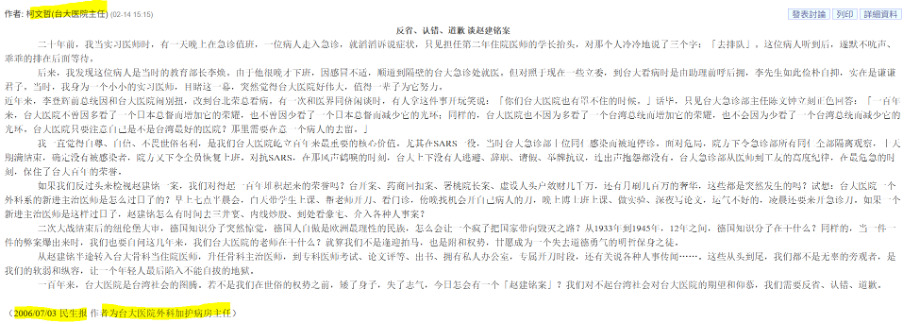
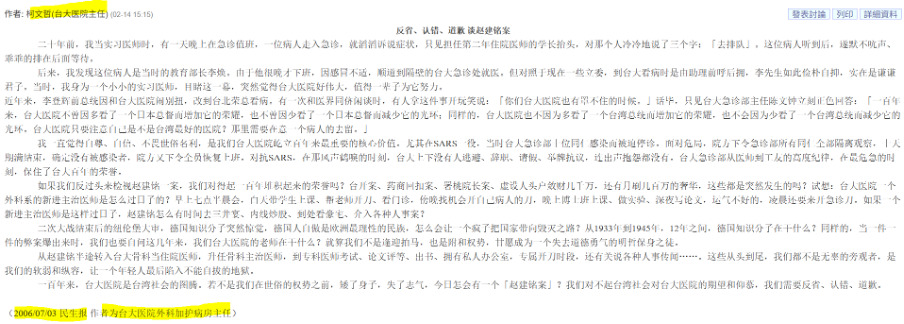
Ko first drew online attention in July 2006, marking the start of his political visibility. This was triggered by his article criticizing the special treatment given to Chao Chien-ming—then-President Chen Shui-bian’s son-in-law—detained for insider trading. Ko urged reflection, admission of mistakes, and a public apology (see Appendix 2).
The largest peak occurred in September 2024. The surge in interest was primarily driven by Ko’s detention on 5 September 2024 and the surrounding media storm. He was investigated for corruption tied to the Core Pacific City redevelopment project during his tenure as Taipei mayor, as well as political donations. Following initial questioning and searches, Ko was briefly released before being detained again. He faced formal charges under the Anti-Corruption Act, including bribery, embezzlement, and breach of trust. Ko denounced the legal process as politically motivated and oppressive. The case sent shockwaves through Taiwan’s political landscape, casting serious doubts over the TPP’s future and its viability as a third political force.[6] This episode received wide coverage from foreign Chinese-language outlets, such as BBC Chinese,[7] Voice of America,[8] and Deutsche Welle,[9] as well as local Taiwanese media.[10] Since this spike in Google search interest was mainly driven by Chinese-language audiences, English-language sources, despite also covering the story extensively, are not included in this discussion. Ko also released a video message online, which garnered over half a million views.[11]
The second-largest peak occurred in November 2018, driven by the Taipei mayoral election on 24 November. In a tightly contested race, Ko secured re-election by defeating KMT candidate Ting Shou-chung with a margin of just 3,567 votes. Ting demanded a recount, which the court approved, but Ko’s victory was ultimately affirmed. His win as an independent candidate demonstrated strong appeal among voters disillusioned with the dominant KMT and DPP, reinforcing his image as a leader of Taiwan’s emerging “third force.” This success laid the groundwork for the founding of the TPP in August 2019, positioned as a centrist party promoting pragmatic, non-partisan governance aligned with third-force ideals.
The third-largest peak occurred in November 2014, driven by the Taipei mayoral election on 29 November. Ko Wen-je—an independent physician and political newcomer—shocked the political scene by defeating the KMT candidate, becoming the city’s first non-KMT mayor in 16 years. This reflected widespread voter disillusionment with the ruling KMT, especially following the Sunflower Movement (Muyard 2015). Ko’s campaign emphasized transparency, efficiency, bipartisanship, and moderation, drawing intense public scrutiny. His victory significantly elevated his political profile, laying the groundwork for his 2018 re-election and broader national ambitions.
The fourth- and fifth-largest peaks occurred in November 2023 and January 2024. During this period, Ko was a key figure in Taiwan’s presidential race. In November 2023, he sought a joint ticket with the KMT to unseat the DPP, but talks collapsed over leadership disputes. This split opposition helped the DPP’s Lai Ching-te win in January 2024. Despite losing, Ko’s campaign drew substantial support, making the TPP a significant minority in the legislature and positioning Ko as a potential powerbroker.
In sum, this section outlines the trajectory of public attention to Ko Wen-je throughout his political career. In July 2006, Ko first drew public notice by commenting on the Chao Chien-ming case. Eight years later, he emerged as a political newcomer and won the 2014 Taipei mayoral election, establishing a personal brand distinct from traditional party politics in Taiwan. His 2018 re-election marked his growing influence in shaping Taiwan’s “third force” movement, which later culminated in the founding of the TPP and broader national ambitions. Although unsuccessful in the 2024 presidential election, Ko and the TPP secured a key minority position in the legislature. However, shortly thereafter, corruption allegations surfaced, leading to his detention in September 2024. He is currently out on bail awaiting trial (as of October 2025).
3. 2024 Presidential Election
Several studies have examined the 2024 election. Yoshiyuki (2024) offered a general overview, noting that a divided government—the Executive Yuan led by the ruling party and a legislature dominated by the opposition—poses both balancing opportunities and uncertainty. Dreyer (2024) additionally analyzed China’s response. Rich (2024) assessed how different voting systems would have affected the outcome. Nachman (2024) focused on third-party dynamics, especially involving the TPP. Other works addressed specific policy themes, such as the 1992 Consensus (Chen and Paris-Rodriguez 2024), domestic policy (Huang 2024), and identity issues (Chang and Fang 2024). Studies by Lee (2024) and Chang, Wang, and Fang (2024) explored information warfare tactics. This study adds to the literature by providing empirical evidence regarding Ko’s popularity and electoral strength.
This section analyzes Ko’s role in Taiwan’s 2024 presidential election. First, Google Trends data are used to compare Ko’s online popularity with that of Lai Ching-te and Hou Yu-ih. Terry Gou, who consistently polled below 13% and withdrew on 24 November 2023, is excluded. Second, Granger causality tests are employed to assess Ko’s online support dynamics.
3.1. Descriptive Comparison
The dataset covers the period from 13 July 2023 to 12 January 2024, capturing the six months leading up to the election. Figure 2 below compares the online search popularity of Ko Wen-je, Lai Ching-te, and Hou Yu-ih during this time frame. Using the arithmetic average of twelve Google Trends samples (available upon request) does not alter the results.
__hou_(red)__and_ko_(yellow)__13.png)
Figure 2 shows that throughout the election period, Ko was generally more popular online than the other two candidates. Notably, just before the election on 12 January 2024, Ko’s popularity surged well beyond theirs. His popularity also spiked on 24 November 2023, when the KMT-TPP joint ticket negotiations collapsed.
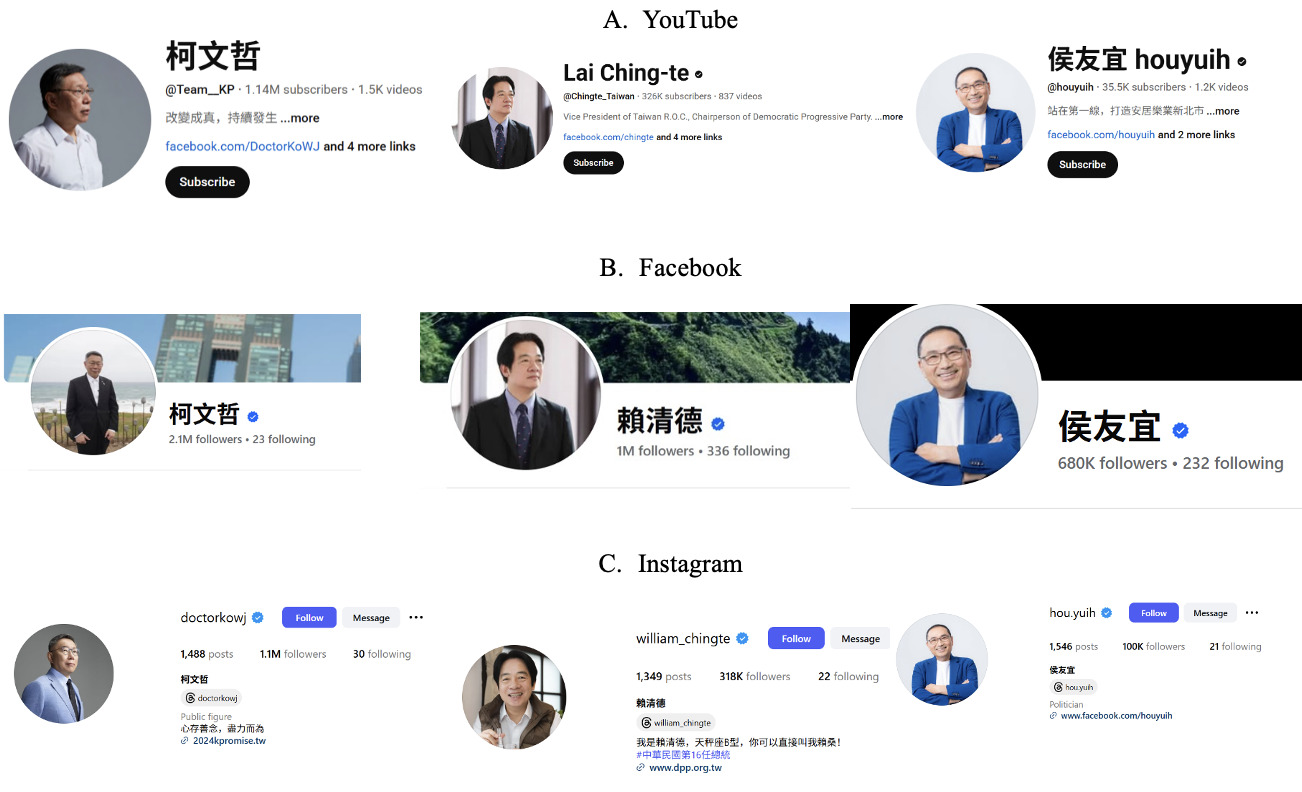
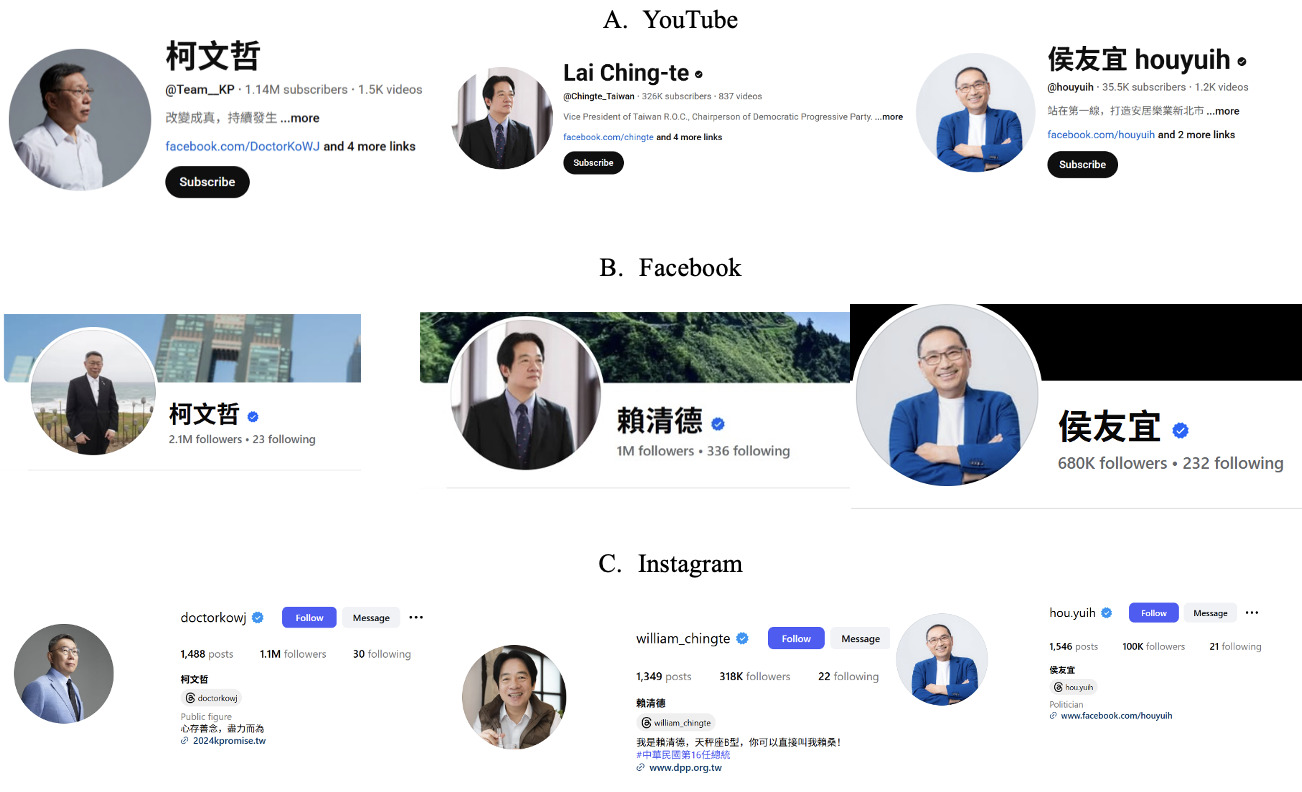
As Hioe and Nachman (2023) observed, Ko sets himself apart by garnering strong support from younger voters. His social media team cultivates an image that is less formal, more direct, and candid. Ko’s online followings across YouTube, Facebook, and Instagram significantly outsize those of the other two candidates (see Appendix 3). According to a TVBS poll on 1 January 2024, just before the election,[12] Ko’s approval among voters aged 20–29 stood at 52%, and 46% among those aged 30–39—both far exceeding the support for his rivals among these age groups (see Appendix 4).
3.2. Granger Causality Tests
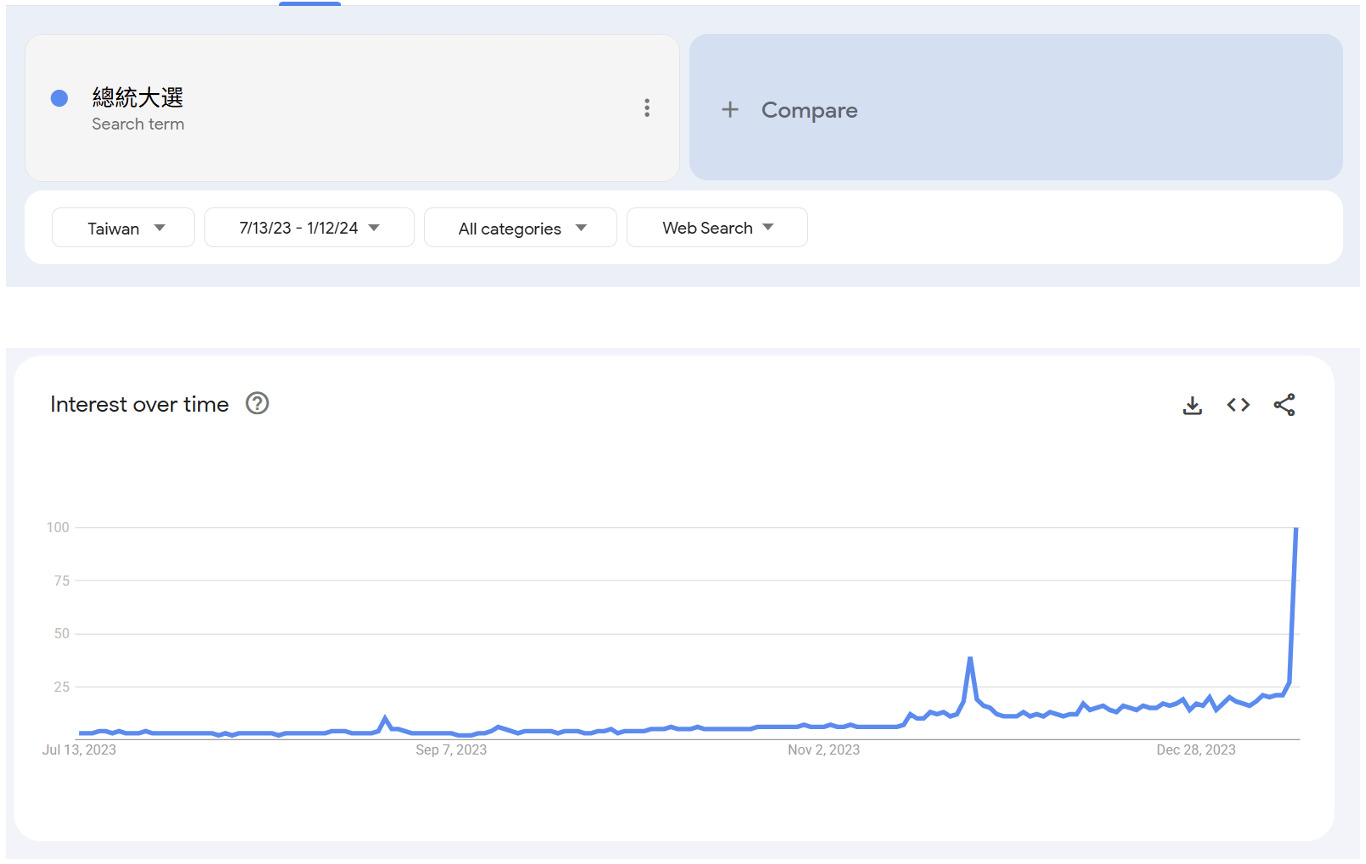
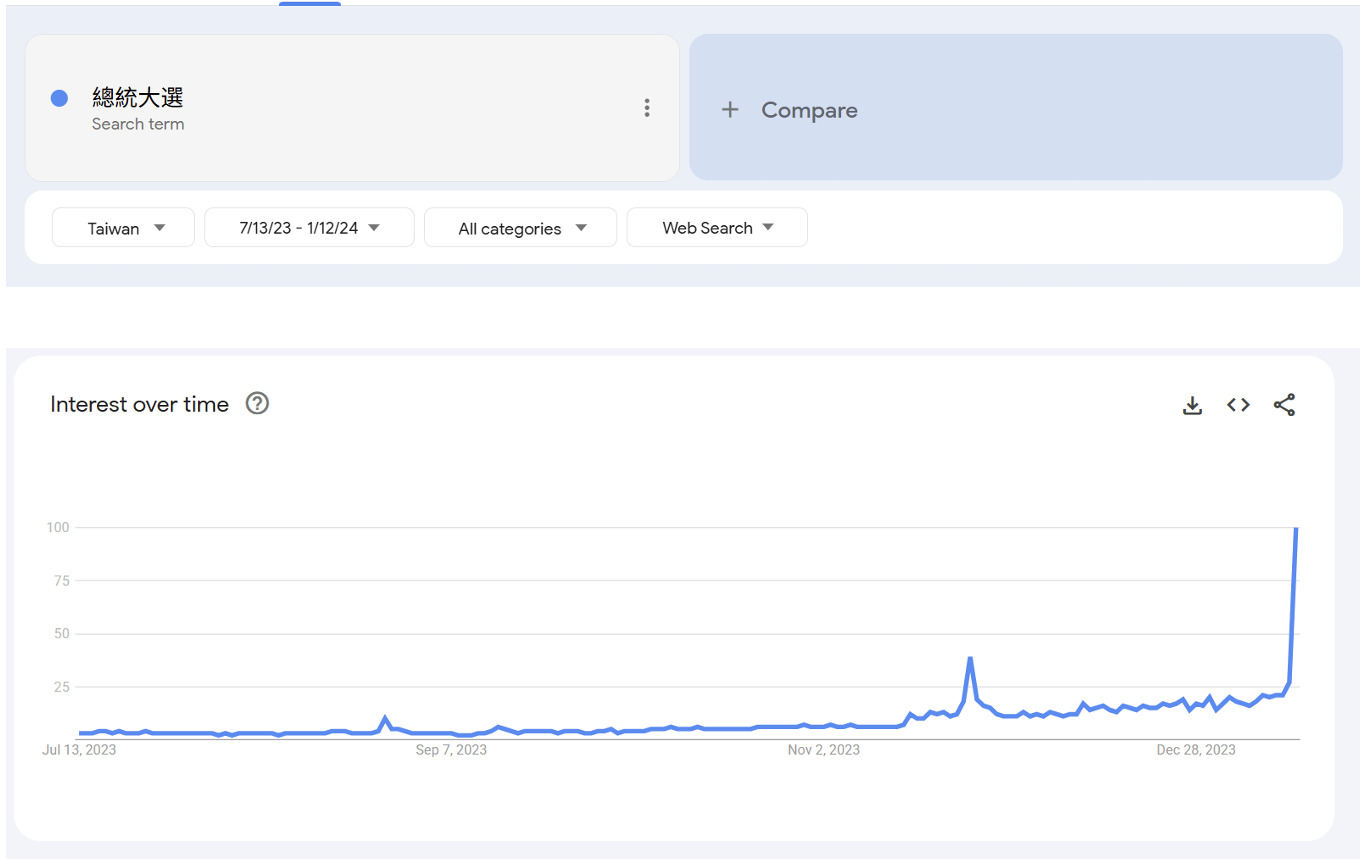
In this part, an additional variable—“總統大選”[13] (presidential election)—was created using Google Trends data (see Appendix 5). It represents the overall narrative around Taiwan’s 2024 presidential election, capturing public interest in topics ranging from candidates’ backgrounds and policy positions to campaign strategies and potential outcomes.
The method adopted here is Granger causality testing. It is a statistical method used to determine whether one time series can provide useful information for forecasting another. If a time series X Granger-causes another time series Y, it means that past values of X contain information that helps predict future values of Y, beyond what is possible using only past values of Y. It is important to note that Granger causality does not imply true causality, only a temporal and predictive relation.
Below, Table 1 presents the Granger causality test results. Since all variables are non-stationary (Augmented Dickey-Fuller (ADF) test results available upon request), first differences were used. Additionally, the arithmetic average of twelve samples was taken to minimize sampling error. Please note that this study treats the 10% level as significant. If the more conventional 5% threshold is applied, the conclusions remain largely unchanged. In addition, increasing the number of lags yields consistent results with the main findings.
“柯文哲” (Ko) influences election-related search interest at lag orders 1, 4, and 6. The early significance of Granger causality at lower lags for Ko (and Lai) likely reflects the behavior of their core supporters, particularly younger voters aged 20 to 39. Given Ko’s strong appeal within this demographic, their active presence on platforms such as YouTube, Facebook, and Instagram translates into rapid search responses and heightened digital engagement. In contrast, Hou’s supporter base is older (see Appendix 5) and tends to engage more slowly online. Accordingly, the later lag significance observed for Hou may suggest delayed digital mobilization.
Notably, Ko exhibits fewer significant lag orders (1, 4, and 6) than Lai (1, 3, 4, 5, and 6) despite his greater popularity among younger voters. This discrepancy likely arises from differences in the nature of their public engagement. Ko’s influence appears episodic, concentrated in short bursts of attention that coincide with events such as campaign debates, controversies, or symbolic moments. This volatility reflects his populist and outsider profile, which thrives on event-driven surges but struggles to maintain stable issue leadership. By contrast, Lai demonstrates a durable agenda-setting capacity rooted in his structural advantages as the ruling party’s nominee. His higher baseline recognition and media visibility allowed him to sustain attention beyond immediate campaign events. These findings underscore that while Ko achieved remarkable spikes, Lai demonstrated the stronger and more sustained ability to shape the online narrative during Taiwan’s 2024 election.
Finally, Table 1 shows that “總統大選” (presidential election) significantly Granger-causes searches for Ko and Hou across all lag orders, but not for Lai. The asymmetry of influence and feedback between candidates and the broader “總統大選” (presidential election) narrative is also revealing. Ko and Hou both exhibit evidence of benefiting from spikes in election-related searches, indicating that their visibility was often reactive and contingent on broader campaign dynamics. This aligns with their relatively lower baseline recognition: Rather than driving election narratives consistently, they capitalized on moments when public attention to the election surged. Lai, by contrast, appears less responsive to such spikes. His role as vice president and ruling party nominee meant that his visibility was already embedded in the election narrative itself, reducing the extent to which he “gained” from election-driven spikes. In other words, while Ko and Hou relied on election-related attention as a catalyst to elevate their profiles, Lai functioned as a more constant anchor of the narrative, shaping rather than depending on shifts in public attention. This asymmetry underscores how different types of candidates—outsiders, challengers, and incumbents—engage in different ways with online attention cycles during campaigns.
4. Concluding Remarks
Ko Wen-je’s rise and trajectory have been nothing short of spectacular, carrying major implications for Taiwan’s “third party” politics and broader political landscape. While some studies have explored this phenomenon, this research stands out by creatively leveraging Google Trends data for a quantitative analysis. It traces Ko’s public emergence in July 2006, highlights his popularity during the 2014 and 2018 Taipei mayoral elections, follows his national ambitions in the 2024 presidential race, and details his arrest and detention starting September 2024. The study also offers empirical evidence of Ko’s online momentum and visibility during the 2024 presidential election. Specifically, Ko’s search interest is driven by younger voters (20–39) and spikes around events. His digital impact is rapid but less consistent than Lai’s. Lower name recognition (than Lai) makes Ko’s visibility more sensitive to election-related trends, prompting reactive search behavior.
Beyond Taiwan’s immediate context, Ko’s trajectory resonates with comparative debates on populism in established democracies. His appeal is grounded in the personalization of politics, reliance on event-driven surges, and disproportionate support from younger voters—features commonly associated with populist movements elsewhere (Kriesi 2015; Moffitt 2016; Zagórski et al. 2025). By positioning himself as an outsider challenging dominant parties and leveraging digital platforms to engage voters, particularly younger demographics, Ko reflects global patterns in how populist actors utilize online channels to amplify visibility and influence political agendas (Engesser et al. 2017).
While this study employs Google Trends to capture shifts in public attention, it recognizes the limitation of relying on a single data source. Future research could triangulate these findings with complementary evidence, such as survey-based approval ratings and measures of social media engagement and media coverage. Mixed-method approaches would provide deeper insight. For instance, one avenue would be examining whether surges in Ko’s popularity coincided with declining support for the DPP or Tsai Ing-wen.
While Google Trends has been used in political science mainly to measure issue salience, it holds potential for more complex multivariate analyses in the field going forward.
Declarations
-
Conflict of interest: none
-
This research received no specific grant from any funding agency in the public, commercial, or not-for-profit sectors.
-
During the preparation of this work, the author used ChatGPT and Grok AI to assist with writing refinement and certain analyses. All content was subsequently reviewed and edited by the author, who takes full responsibility for the final publication.
-
The author would like to thank Austin Wang, the executive editor of Taiwan Politics, and two anonymous referees for their valuable comments on an earlier version of this paper. All remaining errors are the author’s sole responsibility.